What Is Blockchain Technology?
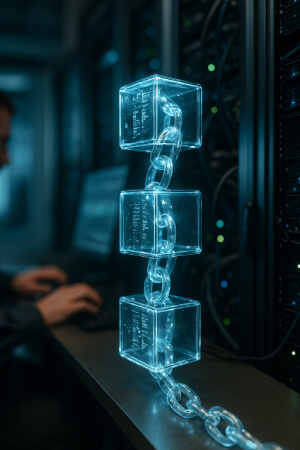
In an essentially distributed database system, a blockchain is one that records and verifies transactions among a network of computers. Therefore, it operates without a central authority. Each transaction is registered in a "block," and the blocks are then assembled in chronological order into a "chain." So, whatever is written in one block cannot be altered without changing every block that follows, making it highly resistant to manipulation.
Albeit considered to have been started for Bitcoin back in 2008, the technology saw extremely active development concurrently over the applications beyond cryptocurrency. Today, with an emphasis on transparency, traceability, and security, the blockchain is applying supply chain management, banking, healthcare, and real estate.
Why Decentralization Matters
Traditional databases are managed by some central authority, such as a bank, company, or government. This type of ownership structure practice is circumvented by the blockchain, distributing the powers across a P2P network. Each participant-named the "node"-is endowed with his/her ledger copy and validates transactions on his/her own. With this disposition, the geeks disappear, and the mutual trust comes amongst participants knowing that no single party can tamper with the data or change the transaction history.
How the Blockchain Works?
A blockchain is interfaced through interconnected features that supply accuracy, transparency, and security. Gaining an understanding of these layers explains why it is deemed the most secure method to store and transmit digital information.
Blocks and Ledgers
The blockchain is a distributed ledger made up of numerous blocks connected to one another. Every block comprises a set of three components: data, i.e., the transactions or information; a hash, which is the digital fingerprint of that specific block; and the previous hash, which links the block superimposed upon it. This creates a continuity of integrity along the chain.
Every time transactions are added on to be built into a block, the transactions are gathered into a single block. This block is then evicted and added on to the chain by the whole network after the consensus has been reached about its validity. Once recorded, the information can never be tampered with, thus creating an almost transparent history that anyone can look into.
Consensus Mechanisms
The so-called consensus networks are established on a set of rules that have been agreed upon by their participants to decide which are valid transactions. The most cited of such consensus mechanisms are explained as follows:
- Proof of Work (PoW): This is Bitcoin's PoW, in which participants must solve difficult mathematical problems that first serve to verify a transaction and then add a new block to the chain.
- Proof of Stake (PoS): These new chains ask for no computational work, but for ownership of tokens; then, validators are selected to verify transactions based upon the amount of tokens they hold and are willing to "stake" as collateral for the verification.
Consensus mechanisms render one free fraud transactions almost impossible since any attempt of doing so would have to take over 51% of the nodes in the network, which is near impossible to accomplish in a big blockchain.
Blockchain and Tokenization
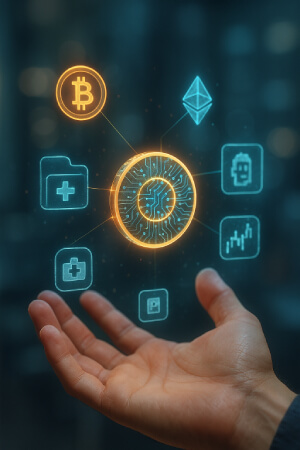
The most emphasized use of the blockchain is tokenization; the representation of any asset in real or digital form and conversion thereof into tokens, which can be traded or operated upon on a blockchain platform.
Types of Tokens
- Cryptocurrency Tokens
- Utility Tokens
- Security Tokens
- Non-Fungible Tokens (NFTs)
Blockchain tokens represent various types of digital assets, and each has a different role within the ecosystem. Cryptocurrency tokens act as digital money, allowing direct payments and transfers between individuals without intermediaries. Utility tokens grant access to the platform, product, or service within the network. Security tokens represent ownership interests or financial rights related to real-world assets such as stocks or property. Finally, NFTs or Non-Fungible Tokens are one-of-a-kind digital pieces that attest to the ownership of art, collectibles, or any other unique items stored on the blockchain.
QUINCOIN (QIN) as a Utility Token
The QUINCOIN differentiates itself from other tokens as one backed by an operating healthcare ecosystem. It acts as payment by accessing services held by Quincare: health data and consultation platform, along with wellness tools; it is also tradable on the crypto exchange bitqin.io.
Working at the intersection of blockchain transparency and real-world utility, QIN supports genuine use cases in the following manner:
- Considered the currency with which users pay for goods and services in healthcare.
- Access Token: Grants access to features in the ecosystem such as reward programs and member services.
- Incentive Mechanism: Encourages participation and engagement in the network.
This application shows tokenization going beyond finances and making a price in industries that affect ordinary people in their day-to-day lives.
Transaction Validation and Security
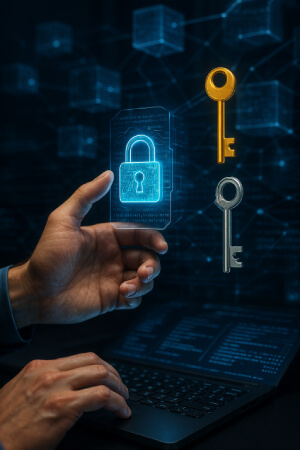
A blockchain derives its authority from the validation and safeguarding of transactions: every step undertaken by any participant across the distributed computer network, be it the sending of cryptocurrencies, recording of contracts, or issuing tokens, has to be validated through layering of cryptography for security and consensus.
Public and Private Keys
Each party forming one block on the chain has exchanged a pair of cryptographic keys to complete a transaction or to prove the ownership of an asset. These keys basically stand for privacy, authenticity, local control, and rights over the digital asset.
- Public Key: It is either a public address used by other parties to send you tokens or ask you to verify a transaction; therefore, it is initially openly shared and can never be used to steal from you.
- Private Key: This is like a digital signature used to approve transactions and access assets, so it must never be shared.
The idea states that the interaction of these two keys precludes the transfer or management of any resource on the blockchain except by the being that originally created it. There is no restoration mechanism from a central authority if you lose your private key, hence the risk of irreversible loss. So users try to protect their private keys and digital assets with wallet devices or encrypted backups.
Hashing and Immutability
The data of each block goes through a hashing process, which converts information to a fixed-length string of characters. Any slight change to the original matter of data generates an entirely different hash value, thus signaling possible tampering. Each node of the blockchain maintains a copy of the ledger, and any disagreeing versions are quickly detected and rejected by consensus.
The data is protected by this combination of hashing and distributed verification, known as immutability-make blockchain records near impossible to alter. Thus, our setting proves much more secure and transparent than a traditional centralized database.
Beyond Cryptocurrency: Blockchain Applications
Although blockchain came into the limelight because of Bitcoin, its use has found various industries. Its power to make tamper-proof records and automate agreements has brought it into the limelight in areas where utmost accuracy and transparency are required.
Supply Chain and Logistics
Blockchain systems allow tracking in real-time, through all stages of procurement, from raw materials to manufacturers through suppliers, distributors, and retailers. Each transaction or movement is entered as an immutable and verifiable recording, establishing a transparent and tamper-proof path history of the product.
An extended traceability level ensures product authenticity and prevents counterfeiting, plus helps to locate any delay or quality issue. Eliminating information silos through a common source of truth dispenses greater accountability and efficiency across intercontinental and complex logistics and supply networks.
Healthcare and Data Management
With a blockchain being created different from the normal and traditional setting, it provides a secure setup to maintain medical records and offer access to medical professionals or institutions. The records are encrypted and time-stamped so that only the authorized participants can view or update patient information. Patients can control who may see or use the information with utility tokens such as QUINCOIN (QIN), thus preserving the privacy of the patient information while still allowing it to be accessed. Through such a decentralized framework, thus allowing healthcare systems to be interoperable and minimize administrative inefficiencies, data are further safeguarded by an open framework for their digital management based on the patient.
Financial Services and Smart Contracts
Banks and financial institutions are adopting the blockchain as a way to streamline and secure their operations. Disintermediation allows them to give cross-border payments in a faster, cheaper, and more transparent manner. It also allows the verification of digital ID where customers may identify themselves once and then no longer have to submit sensitive information. Another very important innovation is the concept of smart contracts, or coded agreements. They have great potential in efficiently enforcing terms in respect of sales or services from the beginning to the end. When parties have either performed their obligations or provided for pre-agreed conditions, these contracts either perform their intended purpose or simply self-terminate, thus minimizing paperwork and the time needed for dispute resolution, guaranteeing the trust among the parties even at the very moment, and avoiding any real reliance on either conventional intermediaries or centralized systems.
Blockchain and Environmental Sustainability
With ever-increasing blockchain adoption, questions arise more and more about its environment-related concerns and how much it favors sustainability. Whereas traditional proof-of-work sees high power consumption, this pressure led to the emergence of more energy-efficient mechanisms like proof of stake and its variants.
By extension, it would also be beneficial for environmental projects, besides the energy aspect. On the surface, it appears to transparently record carbon credits, renewable energy certificates, and sustainable supply chains, thereby helping organizations verify their green claims and curb wastage. Transparency, coupled with accountability, thus makes blockchain the perfect partner in building responsible and environmentally sound digital and industrial ecosystems all around the World.
Rethinking Trust and Value in a Decentralized World
Blockchain is a stack of technologies that goes far beyond financial innovation, and it changes the definitions of trust, value, and information in the modern-day world. Its core principle relies on decentralization, cryptographic security, and consensus validation, providing an unusually transparent system for the masses.
Utility tokens like QUINCOIN (QIN) bring these principles to real-world applications such as in healthcare, where integrity and traceability are of prime concerns. To appreciate how transformative it is, both as the backbone of present-day cryptocurrency and the basis for a more integrated digital tomorrow, one has to understand the functional working of a blockchain.
Explore
I know most persons still find it difficult to understand the concept of Web 3.0
— Viktor (@Viktor_Krypt) November 11, 2025
Let's break it down to the best minimum
Web 3.0 is a concept for a new decentralized internet built on blockchain technology; this gives users greater control of their data's, identity and assets… pic.twitter.com/wNnAoqZAvF
Blockchain hinges on five principles:
— IoT Channel 66 (@66Iot) November 9, 2025
- Cryptography for data security
- Distribution across computers to prevent tampering
- Decentralization for power distribution
- Immutability ensuring permanent records
- Tokenization for easy asset transfer.
RT @antgrasso pic.twitter.com/hqIgL7u3N4