What Are Utility Tokens?
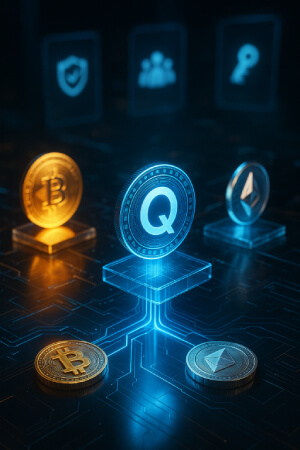
Utility tokens are digital assets designed precisely for use on some underlying blockchain network. Unlike cryptocurrencies such as Bitcoin which are ideally storage of value or a medium of exchange, utility tokens provide holders the right to obtain some product or service. Hence, within their ecosystems, utility tokens are employed for making payments, paying transaction fees, engaging in platform governance, and decision-making concerning the ecosystem.
Thus, by this explanation, it is the utility tokens that provide utility, allowing users to interact with some features on decentralized networks. They might be granting the user access to premium features, discounted transaction fees, or even access to votes for changes in the protocol. The value of such tokens is not based on speculation; it is based on demand for the services that they enable.
How Utility Tokens Differ from Security Tokens
The distinction between utility tokens and security tokens is simple; yet, the two can be confused one for another. Security tokens confer ownership or some sort of investment with ownership rights, such that the result thereof may resemble ownership under stocks or bonds. Utility tokens, on the other hand, are meant for non-investment purposes. For instance, tokens may be used to access a network, take part in that network, or even operate this network.
Considering they are crypto assets that are not intended for profitization, utility tokens generally have not been classified as securities. In recent times, however, regulatory bodies examine how these tokens are structured and are used so as to either determine their lawful status or debar their improper application.
The Role of Utility Tokens in Decentralized Economies
Utility tokens are core means for building a decentralized digital economy. An uninterrupted loop of value-trading among the users, developers, and platform is created with no intervention from any third party. The excitement this exchange creates results in active participation and creativity within the network.
Creating utility tokens that cater to payments, accessibility, and governance would give birth to an operating ecosystem above the blockchain platform. This is evidenced by its application in QUINCOIN (QIN), which incorporates real healthcare applications with the function of a digital asset to exhibit how tokens may be used to merge the real-world industry with blockchain-based economies.
The Core Functions of Utility Tokens
Core functions of utility tokens in decentralized digital ecosystems are few. They consist of being paid with, used for governance, and granting access to special service of any platform. Being the operating life of many blockchain-based projects are the utility tokens.
1. Payments and Transactions
It will be used as obvious cases for fast and transparent transactions, usually paying outside any traditional intermediary. A user pays with the platform's native token for digital goods, networks, paying for premium services, or some fees on the network.
That is to ensure that the ecosystem remains self-sufficient in keeping value internally circulated and maintaining demand on tokens. Sustained and consistent activity over a long period, largely driven by utility, could be far forward to maintaining and building the token's value.
2. Governance and Decision-Making
Utility tokens allow holders to govern over most blockchain networks. Therefore, the users can through token voting schemes, put forth proposals, and vote on changes to the on-chain protocols and policies affecting the ecosystem. This rather democratic set-up ensures that governance is not vested in the developers or founders; instead, it is the active participants who govern.
Governance tokens are merely a sub-category of utility tokens possessing the right to vote. One of the biggest ideas behind a blockchain is that evolutionary changes should be community-driven.
3. Access to Services and Ecosystem Benefits
The utility of a token is that it grants access to services. A token in the dApps and blockchain environment could be equated to a key that opens services, rewards, or integrations. In other words, the more services offered by the network, the more real-world use cases the token has to offer.
This model aligns incentives of users and developers. The better the ecosystem performs is, the stronger will be the use case of the token and its overall value proposition.
Utility Tokens in Action
To appreciate the impact of utility tokens in the real world, one must look at how they function within live ecosystems. Some tokens carry out singular roles, while others lend their agency to the operation of inter-sectoral platforms, such as those involving technology and either health, finance, or data management.
The above instances said that utility tokens are neither IT money nor financial assets but rather an integral part of systems whose functionality lends demand and sustainability to them.
QUINCOIN (QIN)
QUINCOIN (QIN) is an extremely active medium of exchange supported by a fully integrated healthcare system and the digital trading exchange. It runs on a dual platform known as Quincare for health and wellness services and bitqin.io-a crypto exchange for coin trading, staking, and user engagement.
There are three principal usages for the token itself within the ecosystem. The first is as a method of payment on Quincare and bitqin.io. People may use tokens to either pay for services or enter the digital markets. Second, the token also acts as an access token for holders to gain access to health care benefits and digital rewards. Thirdly, another use is one of governance, in the sense that holders of the token can influence the future of the ecosystem through community-led decisions.
From healthcare to crypto trading, QUINCOIN seeks to showcase the versatility of utility tokens as a dual capability of digital operations and the real-world application, thereby affecting a circular economy whereby token circulation assists real-world output.
Integration Across Industries
Utility tokens are relevant for on-the-go transactions and hence may define interconnected ecosystems that might extend into their respective industries. In healthcare, they provide payment options and cross-border transactions for telemedicine and health monitoring and wellness services. In the world of finance, utility tokens might be used to speed up cross-border transactions or serve as a reminder for responsible investment behavior.
This mirrors QUINCIN development through the idea of different token-based systems that may open the value network from healthcare to digital trading by joining disparate user groups. This very interoperability guarantees accessibility, thus sustaining user engagement with a federated experience where every transaction matters for individual human benefit as well as the growth of the ecosystem.
Value Creation and Token Economics

The long-term value of a utility token lies in the utility it delivers insofar as it integrates into an ecosystem. A spur-of-the-moment market hype does not feed a utility token with sustainable demand. When a token serves the basic functions for genuine services, it remains relevant, and such use will inexorably manifest in an economy.
Tokenomics is a system governing the supply, distribution, and circulation of tokens. Good tokenomics seek to ensure that incentives for use do not conflict with the desire to hold value, producing long-term participation rather than short-term speculation. In sum, practical utility, limited supply, staking rewards, and transaction fees influence the market action of a utility token.
Supply, Demand, and Utility
It's all about balance with a proper utility token. If the demand for the services provided by a token increases, people state that the token price must go up; however, an inverse relationship of use and demand makes legit utility tokens distinct from mere speculative assets, which depend merely on price movements.
If a larger number of users are enjoying the health functions through QUINCOIN or trading on bitqin.io, the token is required in greater quantities; in simple terms, the bolder the ecosystem, the more potent the market of the token.
Staking and Participation Rewards
It is said that an additional value gets created every time a token staking system is introduced. Locking up a fixed amount of tokens for a set period safeguards liquidity or provides some stability to the network as the user earns rewards in return. This model motivates holders to stay in contact with one another, thus creating an activity loop that benefits both individual incentives and the health of the ecosystem.
In the QUINCOIN ecosystem, staking shall be used to produce rewards for resource-provisioning, or the needs of health initiatives or project development. By committing their tokens, users strengthen the system's resilience for long-term benefits and build a strong economic foundation for continuous innovation.
Security and Regulation
As blockchain technology grows, so does the scrutiny of regulators. Utility tokens should be governed by evolving legal standards to protect users and maintain ecosystem integrity; hence, developers and exchanges should secure that these tokens are not used for illegitimate objectives and that they safeguard users' data and ensure that financial transactions remain transparent.
While regulatory frameworks may differ between one region and another, consumer protection, anti-fraud measures, and proper classification of tokens usually get most of the emphasis. Projects formed with tokens that are designed to be compliant might well gain credibility and viability over time.
Protecting Users and Data
Security lies at the very center of attribution of legitimacy to any token economy. Secure transactions, trusted identity, any point of interaction in the whole system-the entire lot is in need of proper security to prevent misuse. An additional responsibility gets attached when utility tokens interface with sectors like healthcare, where further data privacy must be preserved and ethical standards followed in data handling.
Ensuring Regulatory Transparency
Transparency, hence, is the fundamental building block of user confidence and regulatory expectation. Those projects which describe openly on how they work on the tokens, data collecting, or fund management usually enjoy more goodwill than average in both the traditional arena and the cryptocurrency arena.
Utility tokens require an audit, tokenomics issues, and a compliance report for the permeability and ensuring accountability of an ecosystem. In the case of QUINCOIN-type tokens, for sensitive-data-related sectors such as healthcare, transparent governance and third-party verification will ensure the user's comfort as well as secure long-term regulatory resilience.
Utility Tokens Driving Real-World Value
Utility tokens are altering how digital systems operate. The worth of a utility is not based on speculation but on its ability to power services, transactions, and community participation. When established upon a clear and fully compliant framework, they offer a sustainable solution for decentralized innovation.
QUINCOIN is an instance of a token that encompasses technology, healthcare, and finance. The QIN program demonstrates that utilitarianize with practical implementation; such digital assets can serve utility services in further industries, farther solely useful, and more durably.
Explore
I know most persons still find it difficult to understand the concept of Web 3.0
— Viktor (@Viktor_Krypt) November 11, 2025
Let's break it down to the best minimum
Web 3.0 is a concept for a new decentralized internet built on blockchain technology; this gives users greater control of their data's, identity and assets… pic.twitter.com/wNnAoqZAvF
Blockchain hinges on five principles:
— IoT Channel 66 (@66Iot) November 9, 2025
- Cryptography for data security
- Distribution across computers to prevent tampering
- Decentralization for power distribution
- Immutability ensuring permanent records
- Tokenization for easy asset transfer.
RT @antgrasso pic.twitter.com/hqIgL7u3N4